Food-safety support
Address the airborne component of a broader contamination-control program.
 CONNECTING SOLUTIONS
Support contamination control and product freshness by addressing the air around food, from production and packaging to storage and distribution.
Explore the approach ↓View the industrial pilot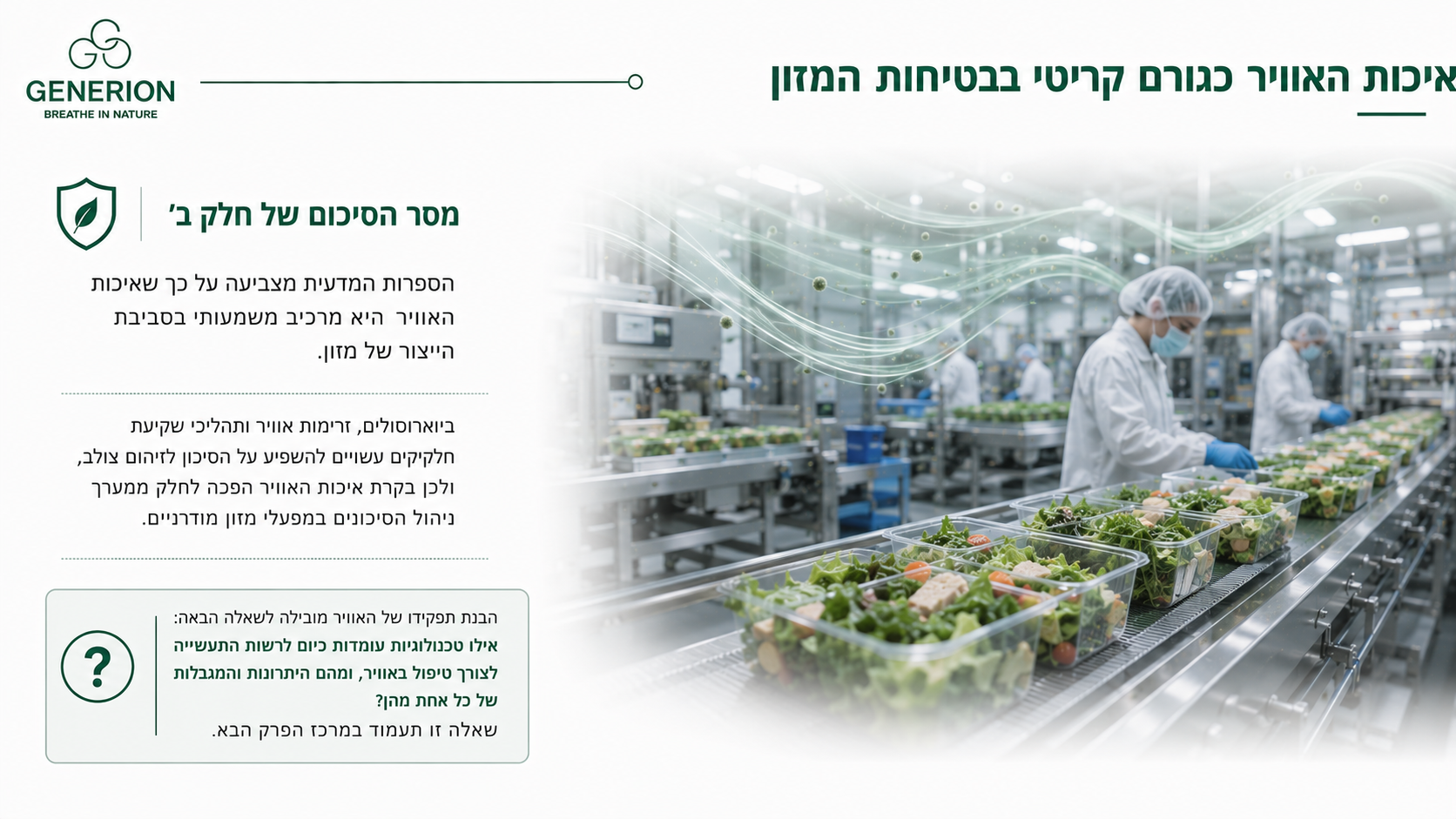
Protection that considers
the whole environment.
Address the airborne component of a broader contamination-control program.
Evaluate the potential to limit spoilage and preserve product quality during storage.
Connect air treatment with the facility’s hygiene procedures and ventilation systems.
Particles and bioaerosols can move through production areas and settle on exposed food, work surfaces and packaging. Airflow between zones is therefore part of understanding contamination pathways.
GENERION’s approach places air treatment within a multiple-barrier strategy alongside cleaning, hygienic handling, filtration and temperature control.
Consider how particles and microorganisms travel through processing and packaging spaces.
Assess exposed products, contact surfaces and the possibility of contamination moving between areas.
Evaluate ventilation, humidity, hygiene practices and air treatment as connected measures.
Controlled growing environments and greenhouse applications.
Fresh-produce handling and packing facilities.
Food preparation, manufacturing and exposed-product areas.
Chilled environments where freshness and storage conditions matter.
Cold-chain transport and distribution environments.
Food storage and display environments closer to the consumer.
 STERIONIZER / INTEGRATED AIR TREATMENT
STERIONIZER uses bipolar ionization technology. The presentation describes integration within HVAC and air-handling systems, and selection of installation points according to the facility and application.
The aim is to address environmental microbial load and spoilage pathways while fitting into the site’s existing operating routines.
The presentation includes examples focused on molds, yeasts and other environmental microorganisms associated with spoilage.
Produce and dairy examples illustrate the evaluation of appearance, freshness and visible deterioration under controlled storage conditions.
Assess each product, packaging format and storage environment through a defined trial and a product-specific quality protocol.
Illustrative examples in the source presentation are not a universal shelf-life extension claim. Outcomes depend on the product, initial condition, packaging, temperature and storage duration.
The presentation describes a pilot at a commercial salad-manufacturing facility, including the pasta-production department, with environmental sampling during normal production.
The pilot followed microbial indicators, including EB, yeasts and molds, using the factory’s internal quality laboratory.
The presentation reports reductions in monitored environmental counts across production, packaging and adjacent areas, compared with the pre-operation period.
The deck also presents storage comparisons for cucumbers, grapes, tomatoes and dairy products, alongside a Volcani research example.
Source: GENERION food-safety presentation, slides 44–47. The pilot findings relate to the case described. This overview does not present them as independently replicated results for every application.
Identify exposed-product stages, airflow routes, hygiene zones and the facility’s current control measures.
Agree on installation locations, baseline samples, a comparison method and a monitoring schedule.
Review environmental results and product-quality measurements before deciding on wider deployment.
Air treatment complements established food-hygiene practices, sanitation and temperature control. Source overview: GENERION food-safety presentation, particularly slides 8–14, 22, 28–31, 44–47 and 52–56.